
Automate Your Podcast Workflow
You can use Zapier to automate your workflow. We expose several Triggers that you can use to make life easier. For instance, you can automatically post to Instagram when your new episode is published.
You can also use our API to build custom workflows, or connect Podhome to AI assistants like Claude using our MCP server. A developer walkthrough of Claude Code plus that API is Agentic podcast automation with Claude Code.
Zapier Triggers
You can use our Zapier Triggers to automate your workflow. Triggers are starting points for your automations. We expose triggers for:
Episode Published:
This trigger starts instantly when you publish an episode in your show. The trigger exposes data about the episode, including title, description, website link, audio and image links, and more
Episode Live Start:
This trigger starts when an episode in your show starts a live broadcast. It exposes the same data as the Episode Published trigger
Zapier can connect Podhome with thousands of applications. Here are some examples of how you can automate your workflow:
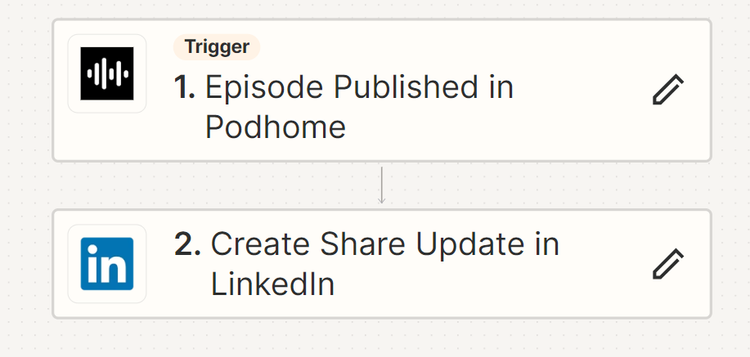
Automatically post to LinkedIn when you publish a new episode
Send an email to a list of people in SendGrid when you publish a new episode
Schedule a social media post for multiple channels in Hootsuite when you publish a new episode
Zapier Actions
In a Zapier workflow (also called a Zap), you can use Actions). We expose the action:
Create new Episode
This action creates a new episode in Podhome, and will process the media file that you feed it, and run Podhome AI if you want
You can for instance use this action to:
Create a new episode in Podhome when you add a new file to DropBox, Google Drive or OneDrive
Create a new episode in Podhome when a recording is finished in Squadcast
Using Podhome with Zapier
To start automating with Zapier, follow these basic steps:
Go to https://zapier.com and log in or sign up
Create a new Zap
For the Trigger, search for Podhome, and select the trigger to start your automation
Zapier will ask you to connect with Podhome. You do this by pasting the API Key from Podhome into the Zapier field
Each show in Podhome has a unique API Key
You can find the API Key for your show in show settings, in the “Integration settings“ section
Once connected, you’ll see the latest data for the selected trigger. You need at least one episode in your Podhome show to see this data
From there, you can add steps to your Zap to automate your workflow. Like one to create a share update on LinkedIn
We can’t wait to see what you automate!
Call the Podhome Integration API
Our REST API gives you full control over your podcast programmatically. Authenticate with your show API key (found in show settings) and you can automate almost anything.
Episodes
Create, update, schedule, publish and delete episodes
Upload audio from a URL or via presigned URLs for local files. Replace audio on existing episodes
Run Podhome AI on new or existing episodes — generate transcripts, chapters, clips, show notes, and title suggestions
Enable Audio Enhancement (noise reduction and loudness normalization)
Upload or link alternate media (e.g., a video version of your episode)
Get episode details including processing status and download counts
Chapters, Clips & People
Add, update and remove chapters from episodes
Create audio clips (soundbites) for social media promotion
Manage people and guests across your show and episodes
Transcripts
Retrieve full episode transcripts, with optional SRT subtitle format
Add SRT, VTT or text transcripts from inline content or a public transcript URL
Delete a specific transcript file, or delete all transcript files for an episode
Add a transcript: POST https://serve.podhome.fm/api/add_transcript
{"episode_id":"123e4567-e89b-12d3-a456-426614174000","format":"srt","content":"1\n00:00:00,000 --> 00:00:05,000\nWelcome to the show!","replace_existing":true}
Add a transcript from a URL: POST https://serve.podhome.fm/api/add_transcript
{"episode_id":"123e4567-e89b-12d3-a456-426614174000","format":"vtt","transcript_url":"https://example.com/transcript.vtt","replace_existing":true}
Delete transcripts: POST https://serve.podhome.fm/api/delete_transcript
{"episode_id":"123e4567-e89b-12d3-a456-426614174000","transcript_id":"b1c2d3e4-f5a6-7890-bcde-f12345678901"}
{"episode_id":"123e4567-e89b-12d3-a456-426614174000","delete_all":true}
Value 4 Value
Read show-level Value 4 Value settings
Read episode-level Value 4 Value settings, including recipients and time splits
Get show-level V4V settings: GET https://serve.podhome.fm/api/v4v
Get episode-level V4V settings: GET https://serve.podhome.fm/api/v4v?episode_id=123e4567-e89b-12d3-a456-426614174000
{"scope":"episode","show_id":"677e5bd6-598f-4522-1134-08dbdac63cde","episode_id":"123e4567-e89b-12d3-a456-426614174000","enabled":true,"type":"lightning","method":"lnaddress","suggested":0.00000005000,"recipients":[{"name":"Podcast host","type":"lnaddress","address":"host@example.com","split":100}],"time_splits":[]}
Webhooks
Register, list and delete webhook subscriptions
Get notified instantly when episodes are published or live sessions start
Analytics
Get download counts, unique listeners, and follower metrics
Break down analytics by podcast app, country, device, operating system, and episode
View time-series trends for growth analysis
Shows
Retrieve show details and settings
Create new shows and modify show settings, artwork, and metadata
Use Podhome with AI Assistants
Podhome supports the Model Context Protocol (MCP), an open standard that lets AI assistants interact with your podcast directly. Connect with Claude by Anthropic and manage your show through natural conversation.
With MCP you can ask Claude to:
List your shows and episodes, check download stats
Create and schedule new episodes, upload audio from a URL or local file
Modify show settings and artwork
Add chapters, manage guests, and create clips
Run Podhome AI to generate transcripts, chapters, clips, show notes, and title suggestions
Upload or link alternate media like video versions of your episodes
Retrieve and summarize transcripts
View analytics: downloads, listeners, breakdowns by app, country, and more
Check your account info and subscription status
Podhome works as a Claude Connector — sign in with your Podhome account and Claude gets secure access to your shows. No API keys needed.